Priest · Pastoral Counselor · Christian Mystic & Druid
Fr. Casey Das
I’ve been labeled, underestimated, and rebuilt from the ground up. Somewhere in all of it I fell in love with grace and with the people it reaches, and I try to meet each of them with the heart of Christ. When people ask what kind of priest I am, I tell them: Mister Rogers meets a Druid.
The Rev. Casey Das, D.Min., Ph.D. · Pastoral Counselor · Ordained 2005, priest since 2009
Doctor of Ministry · Ph.D. in Transpersonal Counseling · Bardic study, Order of Bards, Ovates & Druids
Member, Spiritual Directors International · Member, Spiritual Care Association
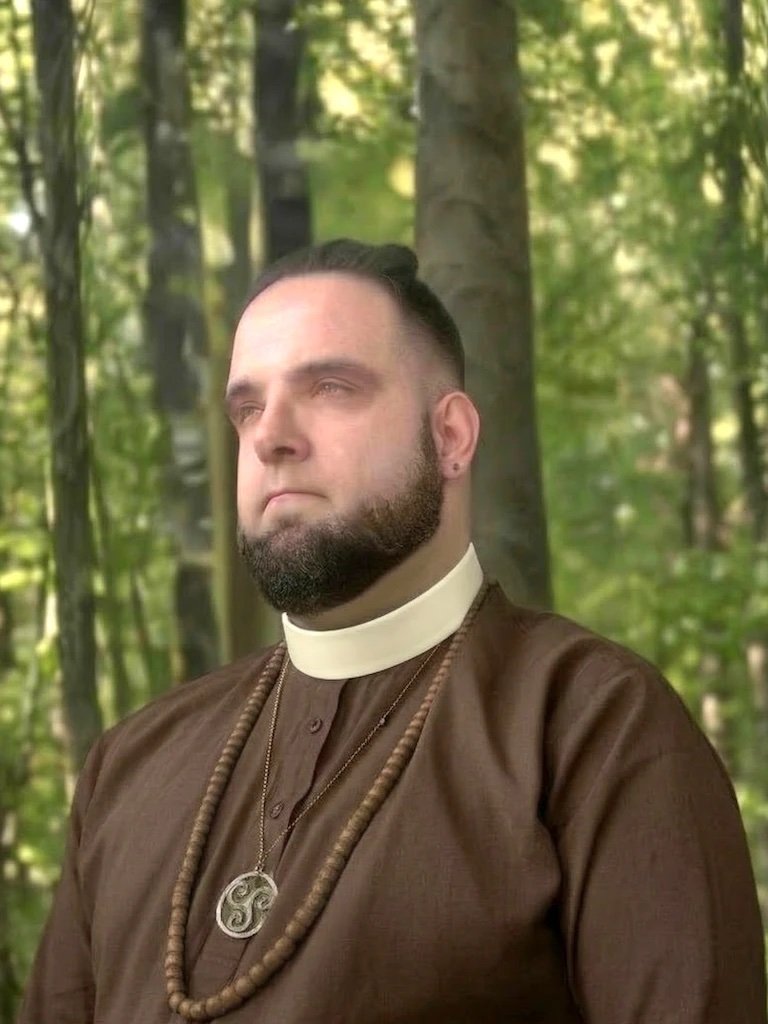
Most of my life has been spent in rooms where people were told who they were before they had a chance to say it themselves: classrooms, hospice rooms, clinics, churches. I keep going back to those rooms because I know what it means when someone finally sees you. This page is a little of my story, what I believe, who taught me, and how I try to give that back.
The Roots
Where I come from
I’m a Gen X kid from the Midwest, raised by my father, by an older mother, and by a television neighbor in a cardigan who told me every afternoon that I was fine just the way I was. I believed Mister Rogers long before I believed much of anything else. His patience, his unhurried voice, his way of looking right at you: that is still my best model for how to sit with another person.
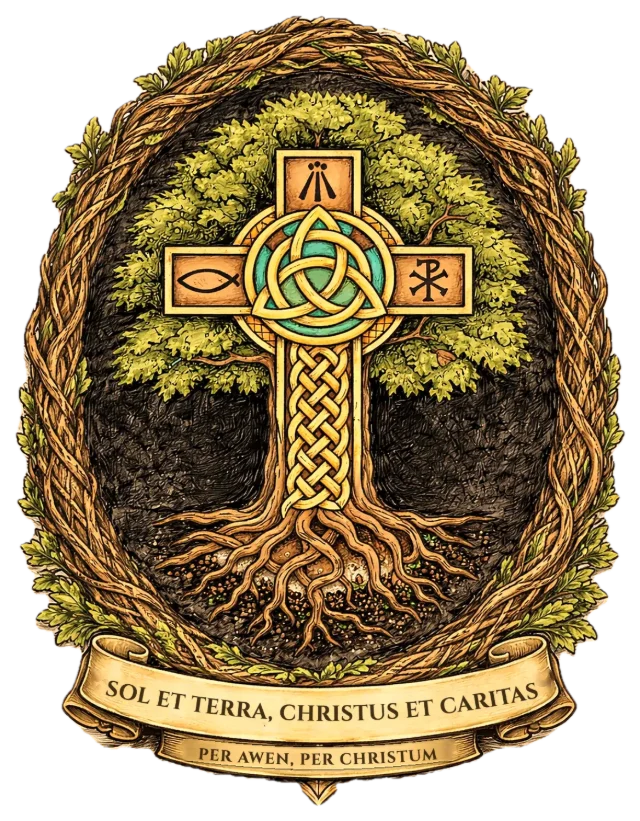
Faith found me as a teenager, in evangelical and Pentecostal churches, the Assemblies of God among them. Those congregations gave me Jesus, a love of scripture, and the conviction that God is alive and close at hand. My theology has traveled a long way since then, but I don’t look back on those years with contempt. They’re my roots. A tree doesn’t cut off its roots because it grew in a direction nobody expected.
I’ve always been better with spoken words than written ones. Give me a conversation, a story, or a blessing said out loud, and I come alive. Maybe that’s why, when I found Druidry, it called me a Bard.
My mother, my father, and all those who came before me are part of everything on this page. When my mother died in March 2024, I found myself on the other side of a conversation I’d had with so many families. I was the one grieving this time. It made me gentler, and more honest about how little any of us can fix.
The Labels
Growing up inside special education
I’ve lived with disability my whole life, and long before anyone called me Father, I was handed other names. I came up through special education. That system was built on a good promise, written into federal law in 1975, that every child has a right to learn. But a system built to include you can also file you away. I learned early what it feels like when a label walks into the room before you do, and people decide what you can’t do before they ever ask what you can.
Those years gave me my first and most lasting lesson about systems, and I’ve lived by it ever since:
Sometimes you learn the rules better than the people who made them, and you use them to open doors. Accommodations, advocates, paperwork: the system can serve you if you know how to make it.
Sometimes the system is simply too small for the person in front of it, and the faithful thing is to walk out, refuse the label, and insist on being seen whole.
And sometimes nothing that exists will do, and you have to create a whole new system: a new way of learning, belonging, or caring for people. Sacred Hearth Pathways is one of those.
I bring that same instinct to every person I sit with. Some people need help working the system they’re in. Some need permission to leave it. And some are ready to build something that has never existed before.
The Threshold
Hospice and life transitions
Much of my ministry has been at bedsides. In hospice, I’ve sat with people in their last days and with the families keeping watch beside them. There’s nothing to fix in those rooms. There’s only presence, honesty, and the holy work of helping someone feel loved on their way home. The dying taught me more about grace than any classroom ever did.
Over time I realized that dying is only one of the thresholds we cross. A new diagnosis, a body that stops working the way it used to, the long weight of caring for someone you love, a vocation that ends, a grief that won’t move on schedule: each one can leave you standing in a doorway, unsure whether to look back or step through. I know that ground personally. When my own body changed, I needed someone to sit with both the spiritual questions and the practical ones, like how to get through an ordinary day.
That’s why life transitions work is so close to my heart. I start by listening, without hurry, to what’s actually happening. Then we sort through it together, find what’s worth carrying forward, and shape it into something you can live with: a few practices, small rituals to close one chapter and open the next, and a step you can actually take this week. Nobody gets the whole route in advance. Usually you only get the next few feet, and that turns out to be enough.
Everything I do now grows out of those rooms: the patience to stay with what can’t be solved, and the conviction that no one has to cross a threshold alone.
The Winter
Several years ago I became a wheelchair user. Everything I thought I knew about my body, my work, and my future came apart. And in the middle of that unmaking, I found I had not been abandoned by the sacred.
For now, my chair is how I move through the world, and it carries me into rooms I couldn’t otherwise reach. I don’t know what my body will be capable of a year from now, and I’ve stopped pretending to. Nothing about us is permanent: not our wounds, not our limits, not even our labels. I’ve come to hear that as one of the most hopeful things I know, and helping people hear it too is at the heart of my flourishing work.
Disability gave me a new set of labels, and it gave me back something I’d learned as a kid: a body that doesn’t fit the system isn’t a broken body. Pain and limitation are not evidence of spiritual failure. Disabled people carry real wisdom about limits, interdependence, and grace, and I now speak about disability as part of my ministry, not an interruption of it. Healing doesn’t ask you to cut off the parts of yourself that are wounded or limited. It begins when you stop exiling them and let them back into the room.
What I Believe
A grace with no outsiders
My faith is rooted in Jesus, and Christ is still the center I come home to. I’m a Christian mystic, and I’m also a Druid. I pray in the language of the cross and the language of the grove, and in all these years I’ve never found that the two compete. My faith has grown wider over time, not narrower. Here is the heart of it, as plainly as I can say it:
- We begin in blessing, not shame.Before anyone ever failed at anything, creation was called very good. That original blessing is still the deepest truth about you.
- God is not far away.Everything lives and moves within God, and God is still more than everything. The Divine is the ocean of being: in the trees outside my window, in each breath, in the stranger at the door, and in the quiet center of your own life. Split a piece of wood, and God is there.
- Grace is not a transaction.Salvation isn’t a legal pardon from an angry judge or an escape plan from a doomed world. It’s a lifelong healing in which we become, by grace, partakers of the divine life.
- Love is how we test a teaching.A belief is only as good as what it does to people. If a teaching shrinks someone’s dignity or teaches them to be afraid of God, I hold it loosely, however old it is.
- Love does not lose anyone.I hold the ancient hope that in the end God will be all in all, every tear wiped away, and the whole of creation gathered home. If grace has no outsiders, neither can I.
- Nothing in you needs redeeming.It isn’t that I doubt redemption. It’s that I trust what was there first. You were never a debt to be paid off or something lost that had to be bought back. The parts of ourselves we’ve hidden away aren’t stains to be removed. They’re pieces of us waiting to be welcomed home. Wholeness comes from holding our light and shadow together.
- The mystery is bigger than our words.No creed, mine included, can hold all of God. I let scripture, tradition, reason, psychology, intuition, and experience talk to each other, and I expect to keep learning until the day I die.
Flourishing
In my manifesto, The Theology of Transformational Flourishing, I argue that people weren’t made to merely survive. Flourishing is more than the absence of pain. It’s what happens when the body feels safe enough to rest, the mind is freed from fear, communities are built on justice and hospitality, and the wounds we inherited from our families begin to heal. A settled nervous system, an honest heart, and a just neighborhood belong to the same salvation.
I also believe that inner peace and outer service can’t be separated. The Celtic monks had two images for this: the cell, the quiet room where you meet God and face yourself, and the coracle, the small boat without a rudder that carries you out to wherever you’re needed. The cell fuels the coracle. I pray so that I can serve.
Cross and Grove
Over the years I’ve found a few words of my own for this path. Cross and Grove: the story of Jesus and the living earth, held together. Christ-Light: the light of Christ that I believe shines in every person, whether they know it or not. Awen and Amen: the Druid’s word for the flowing spirit of inspiration, and the Christian’s word for yes. And the motto I keep coming back to, Lux Divina in Omnibus: divine light in all things.
The Company I Keep
Teachers, saints & companions
No one finds their way alone. I’m one voice in a very old conversation, and I owe a great deal to the people who walked ahead of me, a few in person and most through their books. I don’t agree with all of them about everything, and they don’t all agree with each other. But each one handed me something I still carry.
Closest to my heart
- Richard Rohr
- John O’Donohue
- Thomas Merton
- Fr. Seán ÓLaoire
- John Philip Newell
- Henri Nouwen
- Fred Rogers
Mystics, saints & sages
- Meister Eckhart
- Hildegard of Bingen
- Francis of Assisi
- Rumi
- Thich Nhat Hanh
- Desmond Tutu
- Dorothy Day
- the Desert Mothers and Fathers
Thinkers & wonderers
- Alan Watts
- Eckhart Tolle
- Paul Smith
- David Bentley Hart
- Carl Jung
- Joseph Campbell
- Carl Sagan
- Mary Oliver
Gentle teachers
- Bob Ross
- Steve Irwin
- Winnie-the-Pooh
- Uncle Iroh
And before any of them, my mother, my father, and all those who came before me.
My Contemplative Practice
The wave becomes the ocean.
The ocean becomes the wave.
That’s the closest I can come to describing prayer. In stillness, I let myself sink back into the ocean of God’s presence, the way a wave falls back into the sea. Then I rise again into my particular life, my body, my chair, and the people in front of me, carrying that ocean with me. I was never separate from it to begin with.
A rule of life
Old practices, and new ones
My days are anchored in a handful of practices: the Jesus Prayer, the Psalms, breath prayer, sitting in silence, praying with beads, walking with attention through the natural world, and chanting the Awen, the Druid’s long, sung call to inspiration. I look back over each day for where grace showed up. These practices have carried people for centuries, and they carry me.
But I’ve also learned that when the old forms don’t fit your body or your life, you’re allowed to make new ones. When my body changed, some practices I loved no longer worked the way they were written. So I adapted them, and then I started creating new ones: prayers shaped to the rhythms of my own body, blessings for the ordinary tasks of the day, ways of praying with whatever is right outside the window.
I help the people I work with do the same: honor the practices that have been handed down, and when those don’t fit, craft new ones that do. Your prayer life should fit the person you actually are.
How I Serve Now
Through Sacred Hearth Pathways
Everything above comes together in the work I do now, one person at a time and entirely online. I created Sacred Hearth Pathways to be the kind of place I needed and couldn’t find: spiritually deep, intellectually honest, and safe for anyone who’s been labeled or left out.
The old Celtic name for what I try to be is anam cara, soul friend: someone who listens, keeps you company, and offers what they know, while trusting that your life and your conclusions belong to you. My training in transpersonal counseling lets me hold the psychological and the spiritual in the same room, so you don’t have to leave half of yourself at the door.
-
Pastoral & Spiritual Counseling
→For a hard season: grief, transition, a crisis of faith. Trauma-informed soul care that holds body, mind, and spirit together.
-
Spiritual Coaching
→Where the inner work meets everyday life. We work the system, break out of it, or build a new one, whichever your life is asking for.
-
Spiritual Direction & Companionship
→Once a month, an unhurried hour of paying attention together to where God is already at work in your life. I don’t hand out answers. I help you notice.
-
Contemplative Practice
→Learning the old practices, and creating new ones that fit your body and your life.
I also offer Relationship Hearth Sessions for couples and families, Virtual Chaplaincy, recovery support for people caught in compulsive sexual behavior and for the people who love them, and coaching for life transitions and life alignment.
Good to know: Sessions are online and open to anyone, anywhere. This is spiritual and pastoral care, not clinical therapy, and I’m glad to work alongside your therapist or doctor. It’s a private practice that doesn’t bill insurance, so no diagnosis is ever needed.
You don’t need to share my beliefs. Whether you’re devout, deconstructing, agnostic, or hurt by religion, there’s room for you here.
The people I’ve walked with
“They taught me more than I ever taught them.”
Over the years I’ve sat with students, patients, families, seekers, skeptics, and people the church forgot. Every one of them changed the way I pray. Their names stay with me, and in confidence. Some have chosen to share a little of their own story.
Read · Listen · Follow
Spend some time with me
The best way to know if we’d work well together is to hear how I think.
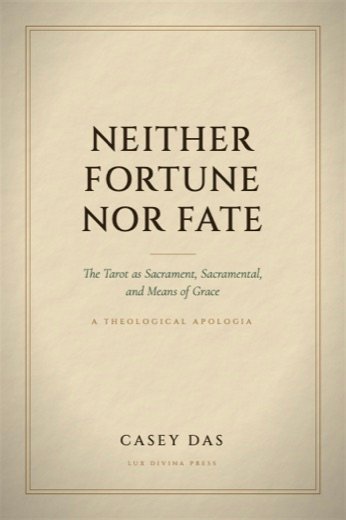 Book · Lux Divina Press, 2026
Neither Fortune nor Fate
The Tarot as Sacrament, Sacramental, and Means of Grace
A theological apologia for tarot in Christian prayer, spiritual direction, and pastoral care, written from the mystical, creation-centered stream of the tradition. Free to read.
Read the PDF →Musings on the Sacred Hearth Pathways
Where I write each week about prayer, the seasons of the inner life, and the holiness tucked inside ordinary days.
Read & subscribe → PodcastAwen and Amen
Long, unhurried conversations about walking the spiritual path together, the natural world, and the God who meets us in it.
Listen on Spotify →Fr. Casey
My personal channels
Sacred Hearth Pathways
My ministry’s channels
Come as you are.
Whatever names you’ve been given, grace has a truer one for you. You don’t need certainty to begin, only a little willingness. May you find stillness enough to hear it, and company enough to keep walking.
In peace,
Fr. Casey (a blessing: the cross and the Awen)
Just want to say hello? Send me a note.